Summary
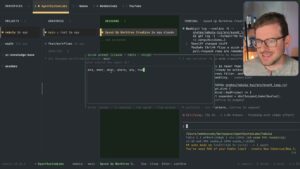
Sentdex (Harrison Kinsley) runs a fully live coding session using GLM 53 Flash to control the high-level decision-making of an XO mini quadruped robot — a wheeled, four-legged platform he has followed for over five years. The video demonstrates why LLMs are becoming a practical alternative to traditional visual-motor approaches like ACT or VAS for robot task planning.
Kinsley argues that simulation-to-real transfer is notoriously fragile, and teleoperated training datasets break down when lighting or task parameters shift even slightly. An LLM controller, by contrast, generalizes naturally: once it knows to pick up a green cube, it can handle color, surface, and lighting variations without retraining. The session covers configuring body pose parameters (shoulder, elbow, and IMU pitch angles), writing cube-detection logic, and iteratively debugging the approach sequence so the robot centers the target in frame before dropping the gripper.
The OM harness provides persistent memory so the model retains context from prior sessions with the same robot. Kinsley shows how a task that would take days with traditional methods — designing an approach-and-grab behavior — can be iterated in minutes with an LLM in the loop. The video is both a practical walkthrough and a broader argument for LLM-driven high-level control as the default starting point for hobby and research robotics.
📺 Source: sentdex · Published September 14, 2026
🏷️ Format: Hands On Build