Summary
OpenAI’s GPT-6.2 Astra has landed to a lukewarm reception from early testers, and this video from Nick Saraev checks whether the criticism holds up. He opens with comments from Dan Shipper of Every, Theo, Ethan Mollick and Matt Shumer, who describe the model as uneven, hard to steer, or in some cases unusable, while noting it can deliver on ambitious projects.
Saraev then runs his own tests. He prompts Astra to build a 3D mechanical watch landing page, a high-fidelity glass-of-water site with a custom GLSL ray tracer, a retro-style 3D shooter, and a photorealistic robot-escape game that uses GPT Image 2.6 to generate art before building 3D assets. He compares the watch page against the earlier GPT-6.1 Terra to show the generational jump.
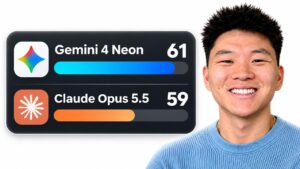
The second half looks at the cost-versus-score Pareto frontier. Astra reaches roughly 77 to 80 percent on the charted benchmarks at a fraction of the cost of Claude Fable 5.2, and posts strong results on Terminal Bench Science. Saraev also addresses accusations of benchmark cherry-picking by pointing to the Artificial Analysis Intelligence Index, and argues that rising expectations explain some of the disappointment. Viewers get a practical look at where Astra shines and where it falls short.
📺 Source: Nick Saraev · Published November 17, 2026
🏷️ Format: Review