Summary
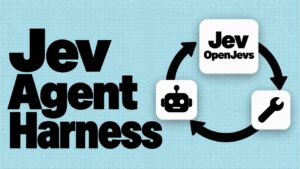
AI Jason introduces harness engineering — a discipline focused on designing systems that allow AI agents to execute complex, long-running tasks autonomously across multiple sessions, reliably picking up where they left off. He traces the concept to a December 2025 inflection point when frontier models first demonstrated the coherence needed for genuinely autonomous work, citing Cursor’s experiment building a browser from scratch with 3 million lines of code using GPT-5.2 and Anthropic’s two-week internal project where Claude Code teams autonomously built a functional compiler capable of running Doom.
The video breaks down Anthropic’s specific architectural patterns for reliable long-running agents, derived from Claude Code SDK experiments. Two consistent failure modes are identified: agents attempting to one-shot entire applications (running out of context mid-implementation) and prematurely declaring completion on features that don’t actually work. Anthropic’s solution uses an initializer agent to set up environment scaffolding — a dev server setup script and a `claude-progress.txt` log — followed by coding agents that make incremental progress and commit clean structured state after each session. Projects are pre-decomposed into 200+ discrete features stored in a JSON task file with pass/fail states, preventing scope explosion.
Jason compares these patterns across Anthropic, Vercel, and LangChain, identifying convergent principles: rich persistent documentation, structured task-state files, incremental git commits, and generic rather than over-specialized tooling. He frames harness engineering as the successor to prompt engineering and context engineering, and positions always-on autonomous agents — exemplified by OpenClaw, an open-source project with full computer access and proactive task execution — as the defining AI paradigm shift of 2026.
📺 Source: AI Jason · Published March 05, 2026
🏷️ Format: Deep Dive